


Viet Tofu opens doors to the world
- Group 8 Class 4
- 16 thg 5, 2024
- 5 phút đọc

Đã cập nhật: 23 thg 5, 2024
10 times cheaper for the same weight and nearly identical delicious flavor as Japanese Tofu, Viet Tofu presents a significant opportunity for Vietnamese producers to enter the global market with high-quality products.
Vietnamese tofu, celebrated for its light, cool, and mild flavor, is earning high praise from culinary experts. With its unique taste and quality, Viet Tofu is ready to make a mark on international markets. This venture promises significant business opportunities while enhancing the reputation of Vietnam's food industry globally.
About Viet Tofu
Tradition is an important factor in the production of Vietnamese tofu. The traditional tofu production process not only ensures product quality but also preserves the unique flavor of Vietnamese tofu.
Specifically, in Mai Dong village, there are still some small, family-based factories that produce traditional tofu, also known as Mo village tofu. Particularly notable is Mrs. Hong's family, which has a long tradition of tofu-making spanning three generations.

Mrs. Hong, a tofu specialist of 70 years, is wrapping tofu in her house
(Photo by PlatyPost)
At 2 - 3 in the morning, the makers have to wake up, wash the beans, grind, filter twice, and boil on a big charcoal stove. Mrs. Hong's house still maintains the tradition of cooking in a charcoal oven because when it boils, the beans will swell evenly and ripen. Additionally, cooking manually like this also helps enhance the flavor of the beans when eaten.


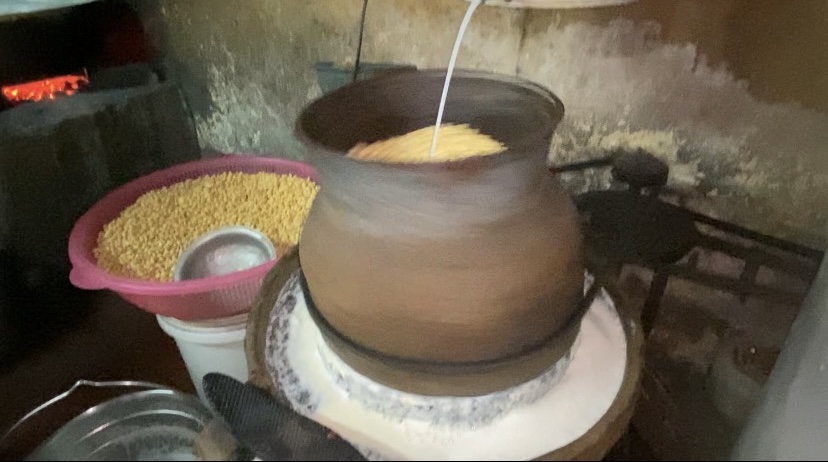

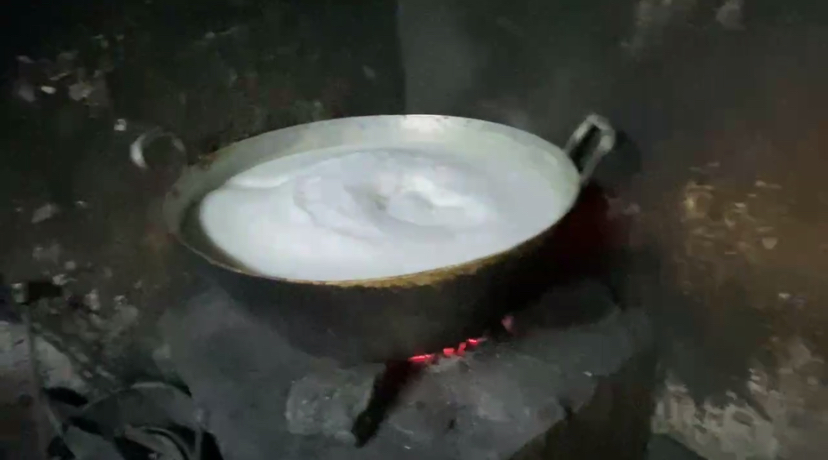
The traditional tools are still in use in Mrs. Hong's house
(Photo by PlatyPost)
After that, it is then mixed with sour water or salt so that it precipitates into a cake called "óc đậu" (bean brains). Each ladle of still-hot "óc đậu" (bean brains) is scooped into a piece of cloth, and placed on a wooden mold to press. The mixture must be packed as hot as possible, if it cools it will spoil.

Mrs. Hong's daughter-in-law is wrapping the tofu
(Photo by PlastyPost)
Lastly, the tofu is hidden under a layer of cloth, the makers only need to peel off this layer, and then the tofu-making process is done.
Vietnamese traditional tofu is best known for its light, soft, and silky texture. The characteristics of Mo village tofu are the ivory white color with smooth surface skin.
It can be said that the Mo Village tofu has a texture quite similar to tofu pudding. The two things are all the taste of freshness, and softness, almost melting in your oral cavity within the first bite. Except for the traditional Viet tofu, it has a firmer texture is not as soft as tofu pudding, and can be picked up with chopsticks, but tofu pudding cannot.
The quality of Vietnamese tofu is unparalleled, with an emphasis on using fresh, locally sourced ingredients and traditional techniques to create a truly authentic and delicious product.
For wholesale price, each piece of tofu will be sold at 1,500VND per piece, retail is 2,000VND per piece. The price is very affordable for anyone, almost too cheap to believe.

Mrs. Hong is carefully unwrapping each piece of tofu
(Photo by PlatyPost)

Japanese Tofu - Viet Tofu’s Competitor Presence in Vietnam
A big challenge to Viet Tofu is the competition for soy products from other countries, especially from Japan. Japanese tofu is renowned for its quality and variety, and it has established a strong presence in the global market. This competition is evident even within Vietnam, where Japanese soy products are gaining popularity.
SoySoy, a Japanese tofu shop in Hanoi, reveals its unique features to compete with Viet Tofu in the Vietnam market.

Mr. Takahiro - SoySoy's founder is preparing Japanese tofu goods
(Photo by PlatyPost)
A notable characteristic of Japanese tofu is the use of Nigari (sea salt) in the production process. Nigari is said to not only help better control the quality but also inhibit the growth of harmful bacteria. Moreover, the procedures for making Tofu are equipped with modern technology, which ensures consistency and production efficiency.

Mr. Takahiro is checking the quality of Tofu with modern technology
(Photo by PlatyPost)
Apart from that, despite making Japanese tofu, SoySoy uses non-GMO soybeans grown in Vietnam, ensuring fresh and high-quality ingredients.
“Although all the production facilities come from Japan, we still choose to collaborate with Hanuti (An organic ingredients provider based in Vietnam) to make our Tofu. After comparing soybeans from many countries, we believe soybeans grown organically in Vietnam would give us the best output” Ms. Tran Thi Thai Bao - COO of Soysoy once shared. This is also a distinctive feature that Vietnam has yet to fully capitalize on, in spite of having more advantages in growing the best soybeans.

Non-GMO soybeans are used in SoySoy's Tofu manufacturing procedures
(Photo by PlatyPost)
Japanese tofu boasts a clean, subtle flavor with a silky-smooth texture, making it a beloved ingredient in global cuisine.

SoySoy's Tofu is ready to eat (Photo by SoySoy)
SoySoy currently sells tofu at the price of 40,000 VND per 300 grams, which is almost ten times more expensive than the price of locally produced Vietnamese tofu.

Perception of texture and flavor through experts’ perspectives
In a recent interview at Thai Pattaya Restaurant - Aeon Mall Long Bien, Hanoi, Chef Ms. Hai Yen emphasized the unique qualities of Vietnamese tofu in comparison to its Japanese counterpart. According to her, Vietnamese tofu's smoother, more fragrant, and denser nature makes it the preferred choice for a wide range of dishes. She noted that cooking with Vietnamese tofu is also easier as it is tightly pressed and holds its shape better, making it more versatile and less prone to breakage.
“At our restaurant, we primarily use Vietnamese tofu for its ease of preparation and better texture, ensuring consistency in our dishes," she said.

Ms. Luong Thi Hai Yen shares her opinions on Vietnamese Tofu and Japanese Tofu
(Photo by The PlatyPost)
Also, Mrs. Tran Anh Nguyet, Director of Mr.Tuk Tuk - Thai Street Food Restaurant chain, expressed confidence in the flavor of Vietnamese tofu compared to its competitors. When considering flavor alone, Mrs. Nguyet believes that Vietnamese tofu has the potential to compete and reach the world just as Japanese tofu has done.

“Vietnamese tofu stands out because it has a distinct aroma, fresh and fragrant, unlike the slightly pungent smell of Japanese tofu.” - Mrs. Tran Anh Nguyet
(Photo by Anh Nguyet Tran)
Export Opportunities for Vietnamese tofu
Vietnamese tofu has significant export potential due to its distinctive light, cool, and mild flavor, which stands out compared to other types of tofu worldwide. With its diverse methods of preparation and use, Vietnamese tofu has the possibility to become an attractive culinary product for many international markets. The rich flavor and high quality of Vietnamese tofu not only meet nutritional needs but also provide unique culinary experiences for consumers globally.
With high praise from experts and competitive flavor, Vietnamese tofu has great potential for export to international markets. Ms. Hai Yen from Thai Pattaya Restaurant - Aeon Mall Long Bien believes “Viet tofu can compete and develop successfully because it has a distinctly different flavor.”
Opening the door to the world for Vietnamese tofu not only offers significant business opportunities but also helps enhance the reputation and standing of Vietnam's food industry on the global stage. However, to export to demanding markets, Vietnamese tofu must meet numerous requirements regarding food safety, product quality, packaging, and weight control for each tofu block.

Vietnamese Tofu is widely available at major supermarkets and retail stores nationwide (Photo by PlatyPost)
For Vietnamese tofu to become a new highlight in Vietnam's processed food export sector, producers can capitalize on the ability to cultivate soybeans domestically rather than using imported soybeans from countries like China and Canada, thereby enhancing the flavor of Vietnamese tofu. Tofu producers should combine traditional production techniques with locally sourced, non-GMO soybeans from Vietnam to make it unique in the market. This approach not only ensures high-quality and fresh products but also supports the local agricultural economy.
FURTHER INFORMATION |
 |
Which Tofu would you choose to use in your everyday meal?
Japanese Tofu
Thai Tofu
Viet Tofu
Chinese Tofu
![[Bài tập giả định] Sinh viên VENE bị bắt giữ vì bán bánh tráng gây nghiện cho bạn học](https://static.wixstatic.com/media/4b4514_f64f871a34d94a7a828c1752d1c4d037~mv2.jpg/v1/fill/w_980,h_735,al_c,q_85,usm_0.66_1.00_0.01,enc_avif,quality_auto/4b4514_f64f871a34d94a7a828c1752d1c4d037~mv2.jpg)


phần poll trông đẹp quá ạ
😍
🤗🤗